about us

CCFN is an active collaboration of community members, agencies, service providers and organizations working together to enhance the health and well-being in our neighborhoods by supporting and coordinating local food security initiatives and improving access to community health, social services and community-based programs. Join us. It's free, fun and makes a difference! Email the coordinator and receive our monthly e-newsletter.

Wednesday, August 4, 2010

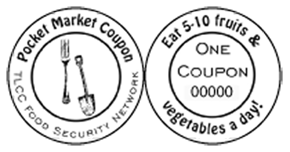
TLCC Pocket Market Coupon Program


Well, after a 6-month hiatus TLCC is back, addressing food security in Trout Lake Cedar Cottage!

TLCC was one of five Neighbourhood Food Networks chosen to receive the Greenest Neighbourhood grant from the City of Vancouver as part of the City’s Greenest City 2020 initiative. TLCC received funding for the Pocket Market Coupon Program which will bring affordable, local and/or organic produce to our neighbourhood. The pocket market will be located near Vanness Ave and Nanaimo St at BC housing's Brant Villa, just east of the Cedar Cottage Garden.

A pocket market is like a small farmers’ market except that farmers don’t usually do the selling. Instead, produce is bought at wholesale prices, either directly from farmers or through a distributor, and sold in areas that don’t have convenient access to fresh fruits and vegetables. Brant Villa is situated in an area that Vancouver Coastal Health has identified as a food desert as there are no grocery stores within walking distance.

The TLCC Pocket Market is a great way for all neighbours to contribute to neighbourhood food security in TLCC.

There are two ways to shop at the TLCC Pocket Market:
  1. With pre-paid Pocket Market Coupons (produce at cost for those on low income)
  2. With cash (a better price than retail)
The Coupon portion of the Pocket Market Coupon Program helps those who are on low income. At the beginning of the month, Coupon Program participants pay $8.00 for 8 Pocket Market Coupons. They then redeem these coupons for produce at the pocket market near the end of the month. The $8.00 they pay is pooled to buy produce at wholesale prices and these savings are passed on to the participants. This means that they receive more produce than if they spent the same $8.00 at retail. Coupon sales will happen through agencies in the area. If you, or someone you know in the neighbourhood is on limited income, look at the coupon sale dates listed below.

To help fund the program for the long term, we will also have cash sales at the Pocket Market. Produce will be priced with a lower-than-retail markup and the profits will be put back into the program. The hope is that in time, the TLCC PMCP will be financially self sustaining.

There will be 10 pocket markets over 10 months at Brant Villa. Here are the dates for the first 5:
  • Sunday, August 15th
  • Sunday, September 12th
  • Sunday, October 17th
  • Sunday, November 14th
  • Sunday, December 5th
TLCC Pocket Market
Brant Villa
2290 E. 25th Ave (just west of the Nanaimo SkyTrain station)
10:00 am - 1:00 pm

Coupons are available at Cedar Cottage Neighbourhood House, 4065 Victoria Dr.

How else can you participate?
  1. Come to the Pocket Market and buy organic and/or local produce
  2. If you are low income, purchase Pocket Market Coupons
  3. Share this blog with friends and family in the area
  4. Volunteer to help set-up the market
.

Wednesday, October 14, 2009

Two Block Diet


At the TLCC Food Security Network meeting in September, Kate Sutherland and Catherine Shapiro came to tell us about the "Two Block Diet", a homegrown success story in Mount Pleasant.

It started with a block party and a conversation about growing food. Kate was talking to one of her neighbours about her lack of garden space and the neighbour offered part of her yard for Kate to grow in. From there the idea of sharing yards to plant gardens emerged and grew into the Two Block Diet.

Their first meeting was held in November of 2008 where about 13 people gathered to discuss how they could support each other to grow more food, reduce their CO2 footprint, teach their children about where food comes from, and build community. The eldest was in her 90’s and the youngest a baby; Catherine, a master gardener, was the most experienced grower and there were others, like Kate, who had never successfully started their own seeds indoors. Together the group shared information and “played”, envisioning what a Two Block Diet would look like.

Through the darker colder months they planned gardens and bought seeds together. Some had yards and others just had balconies; some owned and some rented. During their meetings, often held in someone's living room, they’d plant seeds, just like the old quilting bees! These seeds would be germinated in warm, darker places and then, once they'd sprouted, they were placed in one of the neighbour’s basements under two grow lights the group had bought together. From the city they ordered compost, which they distributed during one of their monthly work parties. At another work party they built a greenhouse, which one of them had bought second hand. As another way to reduce CO2, they strung a clothesline for one of the neighbours in the group, a free and green way to dry clothes. Surprisingly the most onerous task for the group didn’t entail a wheelbarrow, or a hammer, but rather a calendar in order to discuss and set a standard time to meet in their busy lives.

In the spring, the power of many hands was extended to a plant sale so they could raise money to buy bees. (Just in case you are thinking of doing a neighbourhood fundraiser, they found that basil plants were their very best seller.) Raspberry canes were also bought and planted, and in one of the yards they established a collective potato patch.

The neighbours grew for themselves, shared and traded and ate two-block-meals together. The kids foraged and learned how food their food was grown, and everyone learned about community. Two neighbours who had lived just doors away from each other for over 12 years, finally visited each other’s homes. When one of the group fell ill and was in the hospital, they all pitched in to water her garden. That's community.

To start a Two Block Diet group in your community, find at least one other neighbour to help you spread the word. Post some flyers and invite your neighbours to a meeting. Talk about everything your Two Block Diet can be and then start small. If the group doesn't have a master gardener, have a look Robin Wheeler's book, Gardening for the Faint of Heart. Kate and Catherine attribute the group’s success to staying focussed on one thing: to grow more food. With that uncomplicated agenda they were able to grow a great deal more.

Monday, August 31, 2009

Organic Master Gardener Courses


It's time to register for the Organic Master Gardener Course. Finally, a comprehensive organic gardening course for urban garden enthusiasts! Come and gather with like-minded environmentally conscious students and,

* Learn to create fabulous food and ornamental gardens without pesticides and other harmful chemicals
* Become a SOUL Organic Master Gardener and share your knowledge with others through mentorship programs, workshops, talks and many other creative ways
* Gain essential skills to start or enhance your own business in the rapidly growing organic land care industry

Everyone is welcome. No previous experience required. Just come, learn and have fun. This is a practical experience-based course consisting of lectures and hands-on exercises. To receive a Certificate of Completion students must attend all sessions and complete and present a satisfactory assignment. All courses are taught by Heide Hermary.

Daytime Course (Course Number: 074-1, Cost: $695.00)
1:00 pm to 4:00 pm
Tuesdays and Thursdays
September 29th to November 19th

Night Course (Course Number: 183-1, Cost: $695.00)
6:30 pm to 9:30 pm
Tuesdays and Thursdays
September 29th to November 14th

To register please phone Burnaby Adult and Continuing Education at (604) 664-8888, or register online.

A Shorter Course in Soil Management

Don't have enough time for the Organic Master Gardener Course? Check out the 3-Day Intensive Organic Soil Management Course also offered through Burnaby Adult and Continuing Education. Register online, or call (604) 664-8888.

Daytime Course (Course Number: 079-1, Cost: $549.00)
9:00 am to 5:00 pm
Friday, Saturday and Sunday
November 27th to 29th

Soil is the foundation of landscape health. Whether you grow ornamental gardens, turf or vegetables, you need to understand how soil works. In the past we have looked at soil primarily as a "growing medium" - something lifeless and sterile. But soil is the exact opposite - it's an ecosystem, and needs to be managed as such. The greatest biodiversity on earth occurs - or should occur - in the top few inches of soil. Soil ecosystem health and plant health are inseparably linked. Soil processes are universal, applying equally to ornamental landscapes, turf and agricultural crops. Our job is primarily one of fine-tuning.

In this three-day intensive, professional workshop you will learn how to,

* assess the health of your soil, and
* support the natural processes within the soil that result in plant health.

You will also gain a deeper understanding of organic horticulture, and how you can integrate organic practices into your own. For more information please visit Gaia College.

Tuesday, August 25, 2009

The KCC Neighbour: Call for Articles


The KCC Neighbour is a community newspaper by and for people living in the Kensington/Cedar Cottage area that is distributed to 15,000 households and local businesses and organizations. Look for the next exciting edition in October 2009.

They Need Your Content by September 21st, 2009.

The KCC Neighbour focusses on the strength and spirit of the people in our community and emphasizes the partnership between residents, businesses and organizations. Help build the future of this paper.

You can contribute by:
• Writing a story. Some examples include showcasing a member of the community who is making a difference, sharing your community concerns or highlighting the cultural diversity of our neighbourhood. They welcome your ideas!
• Sending in photos. They encourage submissions for their cover and to accompany stories in order to illustrate life in Kensington/Cedar Cottage.
• Providing information about local programs or upcoming community events.
• Advertising your local business in their marketplace pullout. Call for ad sizes and prices, 604-874-4231.
• Joining their dedicated and dynamic Newspaper Committee to help with layout, advertising, editing and overall production. They look forward to your participation!

Friday, July 24, 2009

Year 'Round Harvesting Workshop


Vancouver Community Agriculture Network (VCAN) and the Environmental Youth Alliance (EYA) are again co-hosting a FREE workshop on year-round harvesting.

Come learn how to design your garden so you can enjoy it all year long. Free seedlings and seeds will be given away too.

Date: Tuesday, Aug. 4
Time: 7:00-8:30pm
Location: Eco-Pavilion in the Strathcona Community Gardens (Prior and Hawks).
Reservations: Email hartley@eya.ca